.svg)

The pipeline is full. The sales team is busy. The CRM has contacts. The outreach is running. The content calendar is packed. There are leads in the system.
But the revenue forecast hasn’t changed in three quarters.
The company is generating leads. Plenty of them. What it isn’t generating is demand. And the difference between those two things is the difference between a business that scales and one that plateaus while looking busy.
This distinction is not academic. It is the single most misunderstood dynamic in B2B growth. And getting it wrong is expensive in ways that never show up on a dashboard.
When a B2B company says it needs more lead generation, what it almost always means is: we need more names in the CRM. More form fills. More people entering the top of the funnel. More volume.
The response, whether internal or from an agency, is predictable. Run more ads. Gate more content. Build more landing pages. Launch an outbound sequence. Sponsor a webinar. Add a chatbot. Every tactic is designed to do the same thing: capture contact information from people who may or may not have any interest in buying.
And it works. Sort of. The numbers go up. The lead count climbs. The weekly report looks healthier. The sales team has more names to call.
But something doesn’t move. Close rates stay flat. Average deal size doesn’t change. Sales cycles get longer, not shorter. The team is busier but the revenue line stays where it was.
This is not a lead quality problem, although it looks like one. It’s a demand problem disguised as a volume problem.
B2B demand generation and lead generation are not the same activity. They are not even close. But they get conflated constantly, in strategy documents, in agency briefs, in board decks, and in the way most marketing teams are measured.
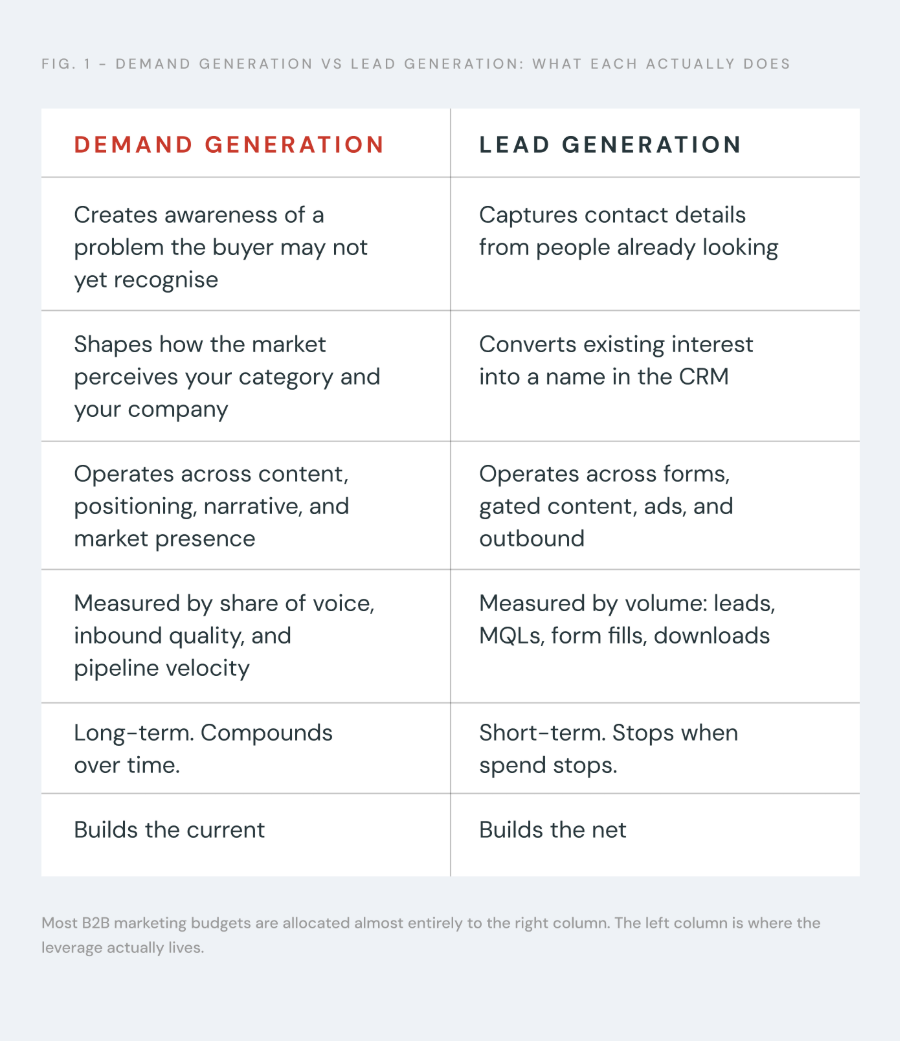
Lead generation is capture. It takes existing interest and converts it into a contact. A name. An email. A phone number. The interest was already there. The lead gen tactic simply harvested it.
Demand generation is creation. It builds the interest that lead generation later captures. It shapes how a market thinks about a problem. It positions a company as the answer before the buyer ever fills out a form. It influences the conversation the buyer is having internally, with their team, their board, their peers, before they even start searching for a solution.
One is a net. The other is the current that brings the fish.
If you only build nets and there’s no current, you’ll catch whatever drifts past. Some of it will be good. Most of it won’t. And you’ll never understand why the volume is high but the conversion is low.
There is a pattern I see repeatedly in growth-stage B2B companies. It runs like this.
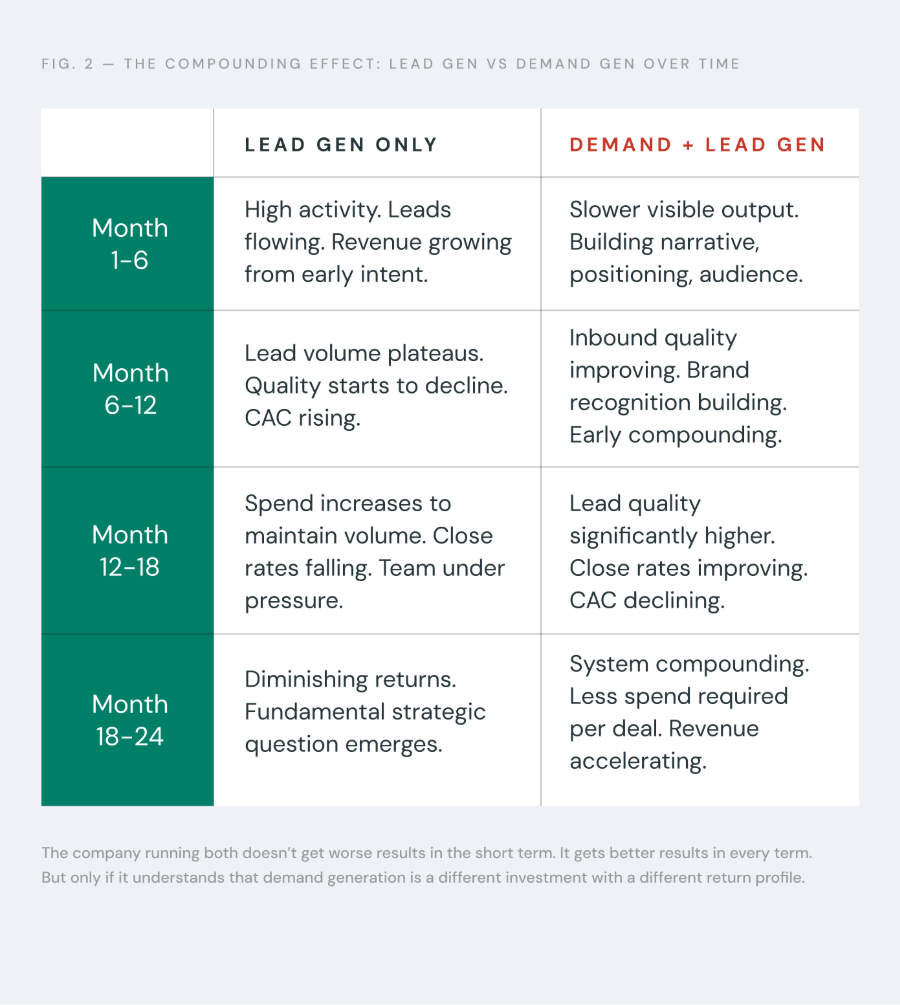
Year one: lead generation is the priority. Paid ads, content, outbound. The company fills the funnel. Close rates are reasonable because early leads tend to be high-intent. The founders are selling. Revenue grows.
Year two: the company scales the same playbook. More spend, more channels, more volume. The lead count goes up. But close rates start to decline. The sales team reports that lead quality is dropping. More meetings, fewer deals. The response is to generate even more leads to compensate.
Year three: the company is spending significantly more on lead generation and getting roughly the same revenue output. CAC is rising. The funnel is wider but not deeper. Marketing is under pressure to justify spend. Sales is frustrated. The board is asking questions.
This is not a failure of execution. The lead generation is working. It is doing exactly what it was designed to do: capture names. The problem is that there is a finite pool of people actively searching for your solution at any given time. Lead generation fishes that pool. When you’ve fished it, you start catching people with less intent, less urgency, less alignment. Volume goes up. Quality goes down. Revenue stays flat.
Demand generation is the thing that makes the pool bigger.
Demand generation is not a channel. It’s not a campaign. It’s not content marketing with a different label. It is a strategic orientation. It’s the decision to invest in shaping how the market thinks about the problem you solve, before trying to capture the people who are already thinking about it.
In practice, it looks like this:
It starts with positioning.
Before you create demand, you need clarity on what you’re creating demand for. Not your product. Not your features. The problem you solve and why it matters now. If your positioning doesn’t articulate a problem the buyer already feels but hasn’t fully framed, your demand generation will fall flat. The narrative has to resonate with something real in the buyer’s world.
It operates where buyers actually spend time.
B2B buyers don’t start their journey on your website. They start it in conversations with peers, in industry content, on LinkedIn, in communities, in the reports and podcasts and newsletters they actually read. Demand generation meets them there. Not with a form. With a perspective. With a point of view that changes how they think about their own business.
It is not gated.
The instinct to gate everything — to put a form in front of every piece of content — is a lead generation instinct. It optimises for capture at the expense of reach. Demand generation prioritises reach. It puts the best thinking in front of the widest possible audience and trusts that the right people will remember you when the time comes to buy.
It compounds.
This is the structural advantage of demand generation over lead generation. Lead gen is linear: spend goes in, leads come out, spend stops, leads stop. Demand gen is compounding: every piece of content, every conversation, every point of view you put into the market builds on the last one. The brand gets stronger. The positioning gets clearer. The inbound gets warmer. The close rates go up, not because the sales process changed, but because the buyer arrived already half-convinced.
If you are a growth-stage B2B company and your marketing is structured entirely around lead generation, you are making a bet. The bet is that enough people already know they have the problem you solve, already know your category exists, and are already searching for a solution. Your job is simply to be there when they search.
For some companies, in some markets, at some stages, that bet pays off. Usually early on, when the low-hanging fruit is abundant and the founders are closing deals through sheer conviction.
But it stops paying off. And when it does, the instinct is to blame execution. The agency isn’t performing. The ads aren’t working. The content isn’t ranking. The sales team can’t close.
In most cases, the execution is fine. The strategy is incomplete. The company is only capturing. It isn’t creating.
This is not an argument against lead generation. Lead gen is essential. You need capture mechanisms. You need forms, landing pages, conversion paths, and systems that turn interest into pipeline. Without them, demand is just awareness with no commercial outcome.
The argument is that lead generation without demand generation is extraction without creation. You’re pulling from a pool you’re not replenishing. And every quarter, that pool gets a little smaller, a little less responsive, a little more expensive to fish.
The companies that grow most efficiently in B2B are the ones that run both, deliberately, with different KPIs, different timelines, and different expectations.
Demand generation builds the market’s awareness of the problem, shapes how they think about solutions, and positions your company as the credible answer. It is measured by the quality and warmth of inbound, by brand recognition in your ICP, by the conversations your sales team reports having with prospects who already understand what you do before the first call.
Lead generation captures that demand. It converts the awareness into pipeline. It is measured by volume, conversion rate, cost per lead, and the speed at which leads move through the funnel.
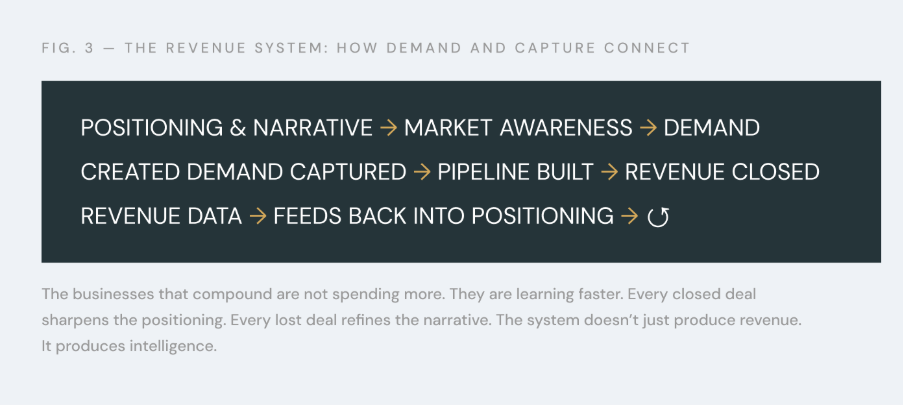
Together, they form a system. Demand creation feeds lead capture. Lead capture feeds revenue. Revenue data feeds back into positioning and narrative. The system compounds.
Apart, they degrade. Lead gen without demand gen becomes a volume treadmill. Demand gen without lead gen becomes brand awareness with no commercial return.
When I sit down with a founder or revenue leader for the first time, I ask one question that tends to reshape the entire conversation.
When a prospect gets on a call with your sales team, do they already understand the problem you solve and why you’re different? Or does the sales team have to build that case from scratch?
If the answer is the second one — if your sales team is spending the first fifteen minutes of every call explaining what you do and why it matters — you don’t have a lead generation problem. You have a demand generation problem. You are capturing people who haven’t been convinced yet. Your marketing is generating contacts, not conviction.
Lead generation can fill a calendar. Only demand generation can fill it with people who are ready to buy.
If this resonated — if you recognised the pattern of increasing lead volume with flat or declining revenue efficiency — the fix is not to stop doing lead generation. It’s to build the other half of the system.
Start with positioning.
Get clear on the problem you solve, who feels it most acutely, and why your approach is different. Not better. Different. The market is full of companies claiming to be better. Very few are articulating a distinct point of view on the problem itself.
Invest in ungated, high-quality content.
Stop measuring every piece of content by whether it generates a form fill. Start measuring it by whether it shifts how your market thinks. The content that drives the most revenue is often the content that never touches a form.
Align your narrative across every touchpoint.
Your ads, your website, your sales deck, your outbound sequences, your LinkedIn presence — they should all be telling the same story. Not the same message. The same story. A coherent narrative about the problem, the stakes, and the path forward. When the buyer moves from one touchpoint to another, the experience should compound, not reset.
Measure differently.
Demand generation cannot be measured the same way as lead generation. If you hold it to weekly MQL targets, you will kill it. Instead, track the quality of inbound over time. Track how many prospects arrive already understanding what you do. Track close rates by source. Track how the sales conversation changes.
The Net and the Current
Every growth-stage B2B company reaches a point where lead generation alone stops producing the returns it used to. The volume is there. The revenue isn’t. The instinct is to cast a wider net.
But the net isn’t the problem. The net is fine.
The current is what’s missing. And until you build it, no amount of capture will produce the growth you need.
James Kevan is Co-Founder of Pieo, a B2B growth agency built around Revenue Science — the practice of diagnosing and fixing the commercial systems behind growth. His work sits at the intersection of data, behaviour, and commercial performance, translating fragmented signals into clear direction for growth.
If you’re generating leads but not demand, start a conversation.