.svg)

The strategy deck is finished. The channels are chosen. The budget is allocated. The campaigns are planned. The team is executing. Everything looks like it should work.
Six months later, the revenue hasn’t moved.
Not because the team is bad. Not because the channels are wrong. Not because the budget is too small. Because the strategy was never really a strategy. It was a list of activities. And a list of activities, no matter how well executed, is not the same thing as a system that produces revenue.
This is the central problem with most B2B digital marketing strategy. It answers the question “what should we do?” when the question that matters is “what needs to be true for this to produce revenue?”
I’ve reviewed hundreds of B2B digital marketing strategies. Built for companies ranging from early-stage SaaS to established services businesses with eight-figure revenue. The format varies. The underlying structure almost never does.
It starts with goals. Usually a revenue target, sometimes a lead target, occasionally both. Then it lists channels: SEO, paid search, paid social, content, email. Each channel gets a plan. Each plan gets a budget. Each budget gets a set of KPIs. The whole thing is assembled into a document or deck that looks comprehensive and professional.
And almost none of it addresses the thing that will actually determine whether it works.
The strategy describes what the company will do. It does not describe what the buyer will experience. It is built from the company’s perspective, organised by channel, measured by activity. The buyer’s journey through it is an afterthought, if it’s considered at all.
This is why so many B2B digital marketing strategies produce activity without outcome. The plan is internally coherent but externally invisible. The buyer doesn’t experience your channel plan. The buyer experiences a series of moments — an ad, a page, a piece of content, a conversation — and either those moments build toward a decision or they don’t.
In fifteen years of building and scaling businesses, I’ve found that B2B digital marketing strategy either works or fails based on three things. Not thirty. Not ten. Three. Everything else is execution detail.
1. Is the narrative aligned to what the buyer actually cares about?
Not what you think they should care about. Not what your product does. Not what differentiates you from competitors. What the buyer is trying to solve, in their language, with their urgency, in the context of their actual situation.
Most B2B messaging is written from the inside out. It starts with the company’s capabilities and works backward toward the buyer’s problem. The result is messaging that is accurate but not resonant. It describes what you do without connecting to why it matters to the person reading it.
A digital marketing strategy built on misaligned messaging will underperform regardless of how well the channels are managed. The targeting can be precise. The creative can be polished. The budget can be generous. If the message doesn’t land, nothing downstream works.
2. Does the buyer’s experience compound or reset at each touchpoint?
A buyer clicks an ad. Arrives on a landing page. The landing page says something slightly different from the ad. They navigate to the homepage. The homepage tells a different story. They download a guide. The guide is about something adjacent. They get an email sequence. The sequence talks about features.
Every touchpoint resets the conversation. The buyer never builds momentum. They never accumulate conviction. Each interaction is isolated, disconnected from the last, asking the buyer to restart their understanding of why this company matters.
Compare this to a company where the ad, the landing page, the content, the email, and the sales conversation all tell the same story. Where each touchpoint builds on the previous one. Where the buyer arrives at a sales call already understanding the problem, already persuaded of the approach, already half-committed. That’s not better marketing. That’s a different system entirely.
3. Is the strategy measured by what it produces or what it does?
Most B2B digital marketing services are measured by activity. Impressions delivered. Clicks generated. Leads captured. Content published. Rankings achieved. These are output metrics. They describe what the marketing did, not what it produced.
A strategy that supports revenue growth has to be measured by commercial outcomes. Not just pipeline. Not just MQLs. Revenue. Close rate by source. Time to close by channel. Revenue per pound spent by campaign. Customer lifetime value by acquisition path.
This doesn’t mean ignoring channel metrics. It means subordinating them. The channel metrics are diagnostics. The commercial outcomes are the scorecard.
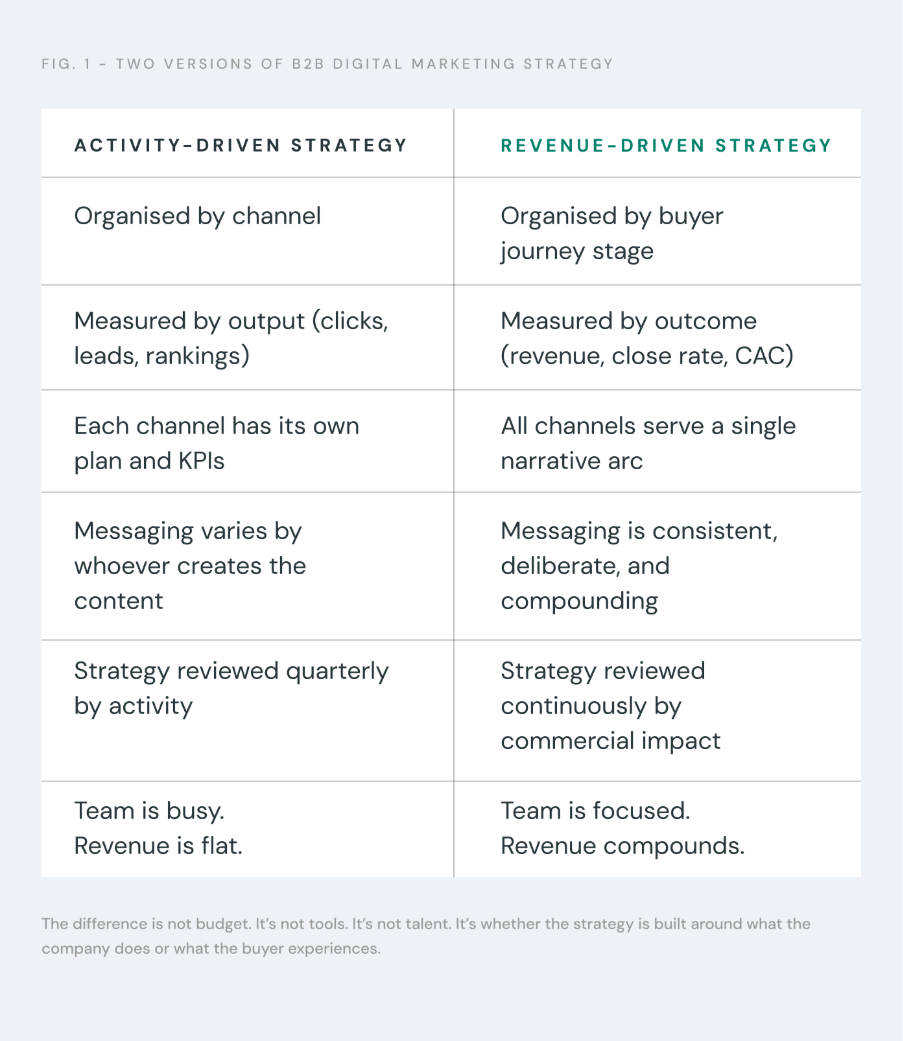
If you’re working with a digital marketing agency or an in-house team and the strategy feels activity-driven rather than revenue-driven, the reason is almost always structural, not individual.
Agencies are typically organised by channel. There’s an SEO team, a paid team, a content team, a social team. Each team has its own deliverables, its own reporting, its own definition of success. The SEO team reports on rankings. The paid team reports on ROAS. The content team reports on traffic. Nobody reports on whether the buyer’s experience across all of these channels tells a coherent story.
In-house teams face the same problem from a different angle. The marketing manager is responsible for executing across channels with limited resources. The pressure is to do things — publish, launch, optimise — not to step back and ask whether the thing being done is aligned to a commercial outcome.
The result is the same in both cases. High activity. Low alignment. Strategy that looks comprehensive on paper but fragments in execution.
The shift from activity-driven to revenue-driven B2B digital marketing strategy is not about adding more. It’s about connecting what’s already there. In most cases, the channels are right. The team is capable. The budget is adequate. What’s missing is the connective tissue.
It starts with the narrative, not the channel plan.
Before choosing channels, before allocating budget, before building a content calendar, the strategy must answer one question: what is the story we are telling, and does it match what our buyer cares about? This is not copywriting. It’s positioning. It’s the decision about what problem you lead with, what language you use to describe it, and what outcome you promise. Every channel decision flows from this.
Channels are sequenced, not siloed.
In a revenue-driven strategy, channels don’t operate independently. They are sequenced to reflect how a B2B buyer actually moves toward a decision. Awareness channels build familiarity. Consideration channels provide depth. Conversion channels remove friction. Each one hands the buyer to the next with the narrative intact.
This is different from running channels in parallel and hoping the buyer encounters enough of them. Sequencing is deliberate. It requires understanding which channels your ICP encounters first, what they need to hear at each stage, and how the message should evolve as commitment increases.
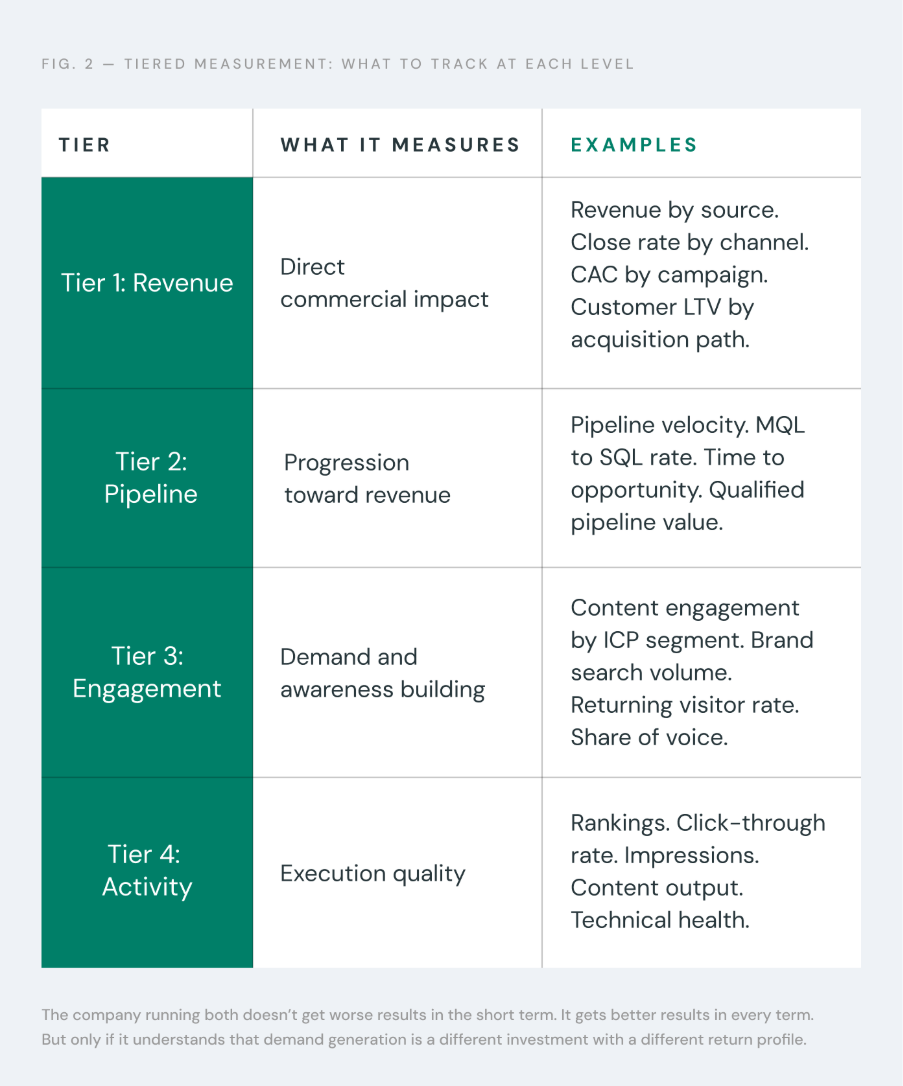
Measurement is tiered.
Not everything can be measured by revenue immediately. Some channels contribute to awareness that converts months later. Some content influences deals that close through a different path entirely. A revenue-aligned strategy acknowledges this by measuring in tiers.
There’s a specific failure mode I encounter in almost every B2B company I work with. It’s not a channel problem. It’s not a budget problem. It’s a messaging alignment problem, and it’s invisible until you go looking for it.
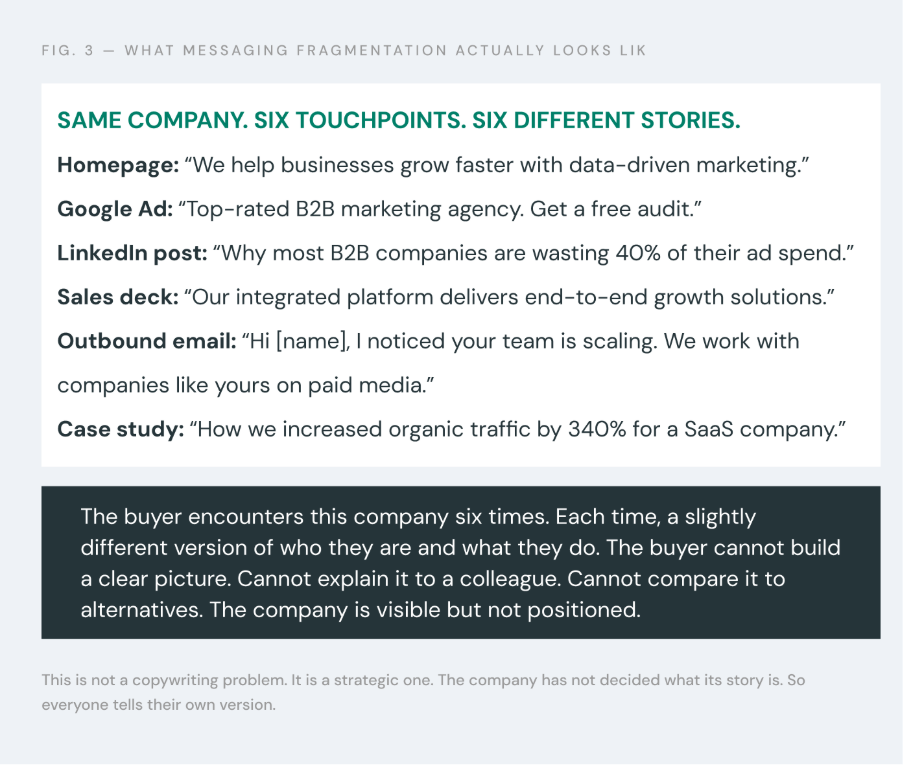
Here’s how it shows up. The company’s homepage says one thing. The Google Ads say something slightly different. The LinkedIn content has a different emphasis. The sales deck tells a different story. The outbound emails lead with a different angle. The case studies highlight different outcomes.
None of these are wrong individually. Each one was created by a competent person trying to communicate value. But collectively, they create a fragmented experience for the buyer. The buyer encounters the company five times and hears five slightly different versions of what the company does and why it matters.
The effect is subtle but devastating. The buyer never builds a clear mental model of the company. They can’t place it. They can’t articulate what it does to a colleague. They can’t compare it to alternatives because they’re not sure what category it belongs to. The company is present in the market but not positioned in the buyer’s mind.
This is a positioning failure expressed as a marketing problem. And no amount of channel optimisation will fix it.
The fix is not complicated. But it requires doing something that most companies skip because it feels like it’s slowing things down. Before optimising any channel, before increasing any budget, before launching any new campaign, answer these questions:
What is the one problem we lead with?
Not three problems. Not a capabilities list. One problem that your ICP feels acutely, that they’re actively trying to solve, and that you have a distinctive perspective on. Every piece of marketing should connect to this problem. If it doesn’t, it’s diluting your positioning.
What is our point of view on this problem?
Not just “we can solve it.” Every competitor says that. Your point of view is your angle. It’s the thing you believe about this problem that your competitors don’t say, won’t say, or haven’t thought of. It’s the reason a buyer should listen to you specifically.
What does the buyer need to believe, in sequence, to choose us?
This is the journey question. Before a buyer signs, they need to believe a series of things. They need to believe the problem is real. That it’s urgent. That the current approach isn’t working. That a different approach exists. That your company delivers that approach. That the risk of switching is manageable. Your B2B digital marketing strategy should map to these belief stages, not to channels.
Are all our touchpoints telling the same story?
Audit every touchpoint. Your ads, your website, your content, your emails, your sales materials. Do they tell the same story? Do they build on each other? Or does each one start from scratch? The audit is simple. The discipline of maintaining alignment is hard. But it is the single highest-return investment in any B2B digital marketing strategy.
There’s a hidden cost to misaligned B2B digital marketing strategy that never appears in any report. I call it the strategy tax.
It’s the cost of every prospect who encountered your company three times and still couldn’t explain what you do. The cost of every sales call where the rep spent fifteen minutes establishing context that the marketing should have already built. The cost of every qualified lead that went cold because the gap between what the ad promised and what the website delivered created doubt.
The strategy tax is paid in longer sales cycles, lower close rates, higher CAC, and slower growth. It doesn’t appear as a line item. It appears as the gap between what your revenue should be and what it actually is.
Most companies try to close this gap by spending more on acquisition. More ads. More content. More channels. More volume. But spending more on a misaligned strategy doesn’t fix the misalignment. It amplifies it.
A B2B digital marketing strategy that supports revenue growth is not a better channel plan. It’s not a bigger budget. It’s not more content or more campaigns or more tools.
It is a decision about the story you are telling. A commitment to telling it consistently, across every touchpoint, at every stage of the buyer’s journey. And a measurement system that holds the whole thing accountable to commercial outcomes, not activity metrics.
The companies that grow most efficiently are not the ones doing the most. They are the ones whose marketing says the same thing, everywhere, in a way that compounds the buyer’s conviction with every interaction.
That is what strategy means. Not a plan for what to do. A system for what the buyer will believe, and in what order, and why it leads to revenue.
James Kevan is Co-Founder of Pieo, a B2B growth agency built around Revenue Science — the practice of diagnosing and fixing the commercial systems behind growth. His work focuses on how positioning, messaging, and market perception influence performance across the full funnel.
If your digital marketing strategy is producing activity but not revenue, start a conversation.